



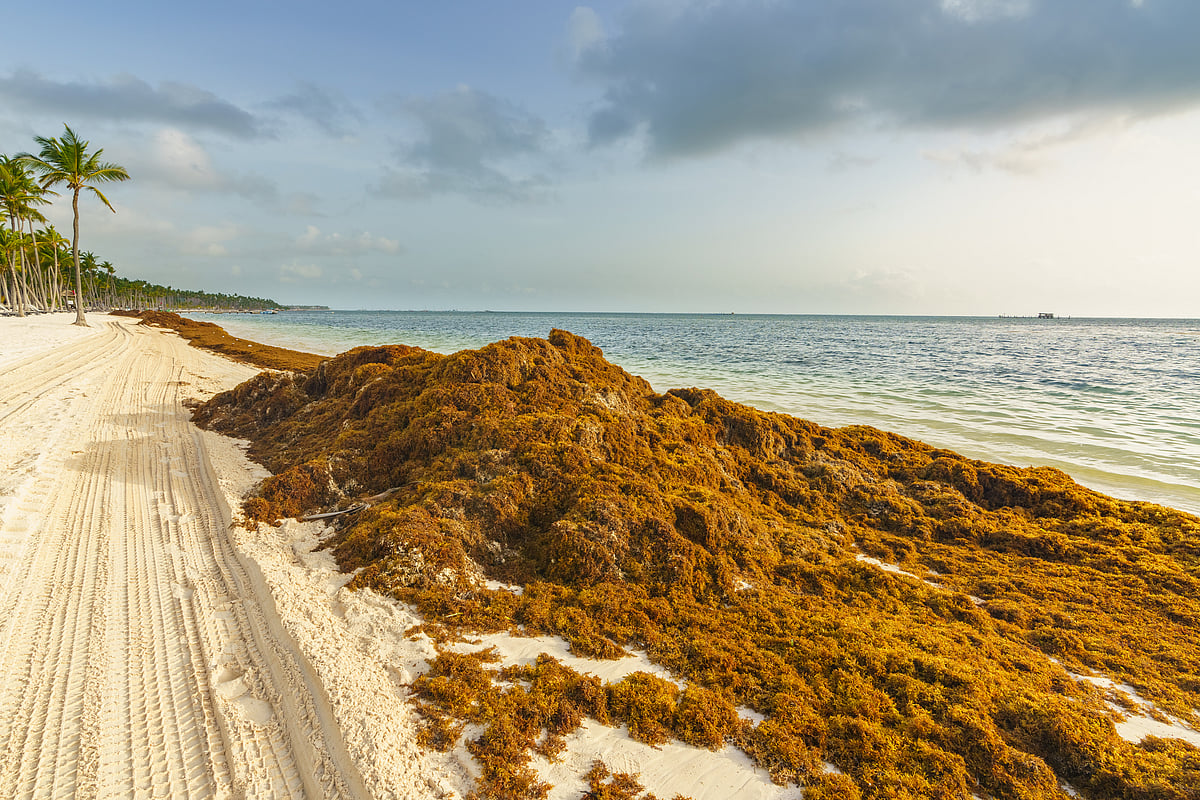
Seaweed blooms are increasingly being reported along coastlines around the world, including in Europe, Asia, and the tropics.
Both native and non-native seaweeds occur in non-negligible amounts and at unusual or surprising times of the year.
As an Earth observation and remote sensing scientist, I track these flowers from space using high-resolution satellite imagery. According to my research, seaweed blooms are getting bigger and bigger.
My team’s 2025 study revealed a significant increase in sargassum blooms in the northeastern tropical Atlantic, with an astonishing 2.6 million tonnes stranded in September 2020. This is the first long-term analysis of wakame flowering trends in this region from 2011 to 2022.
These unpredictable seaweed tides have serious implications for coastal communities and marine ecosystems in West Africa. Our study shows that rising sea surface temperatures are closely associated with peak seaweed growth. Essentially, warmer temperatures encourage seaweed growth, which can lead to a surge in blooms.
Seaweed blooms are not a new phenomenon. However, over the past 15-20 years, its size and persistence have increased significantly.
Of particular concern is floating seaweed. They are species that float on the surface of the ocean, either leaving the ocean floor or spending their entire lives floating. Unlike seaweed that is anchored to the ocean floor, floating seaweed can travel long distances to new areas, accumulate in large mats, or wash up on shore in large quantities.
One example that I have spent much of my career researching is Sargassum. Like a scene from a science fiction movie, I have seen mats of Sargassum seaweed stretching across the tropical Atlantic Ocean, reaching depths of 7 meters and spanning hundreds of square miles.
Most sargassum species are anchored to the ocean floor, but two species, Sargassum natans and Sargassum fluitans, are completely floating. They float freely on the ocean surface, kept buoyant by tiny air-filled grape-like sacs called pneumatocysts, which lift them toward the surface for photosynthesis.
Our research shows that since 2011, large blooms of Sargassum seaweed have appeared across the tropical Atlantic, piling up in the Caribbean, the Gulf of Mexico, and increasingly on the coasts of West Africa. This drifting seaweed makes fishing difficult and causes disruption to coastal areas.
Seaweed plays an important role in marine ecosystems, but excessive growth can destroy marine ecosystems. Large floating mats block sunlight and limit the growth of seagrass and coral below. Seaweed can also change oxygen conditions in the water, creating a hypoxic environment that is harmful to marine life, especially when it decomposes in protected bays and beaches.
Some of the most noticeable effects are seen in wildlife. In tropical regions, sargassum accumulates on sea turtle nesting beaches, with recent studies suggesting that up to a quarter of nesting sites may be affected. The newly hatched chicks struggle to navigate both sand and dense seagrass until they reach the ocean, exhausted. This reduces the chances of survival.
All of Europe
Sargassum has actually entered British waters as an invasive species, but Sargassum flowers are not as extensive as they are in the tropical Atlantic. Blooms of other types of seaweed are becoming more prominent in the UK and Europe. For example, Ulva, the green seaweed known as Ulva, regularly forms dense mats on the sea surface in places like Poole Harbour, Dorset.
Ulva is native to Britain’s coastal ecosystems in small quantities and is largely harmless. However, if it blooms excessively, problems can begin to occur. Thick mats on the water’s surface reduce the amount of sunlight reaching seagrass and other organisms below, but decomposition can reduce oxygen levels in the water, creating stressful conditions for fish and invertebrates, resulting in plant and animal mortality.
There is growing concern about invasive seaweeds across Europe. In the Mediterranean, species such as Rugropteryx okamurae (native to the northwestern Pacific) spread rapidly and were probably introduced via shipping routes. These seaweeds attach to the ocean floor, then break off, drift long distances, and then reattach elsewhere, allowing them to spread efficiently along coastlines. Large amounts of sediment are currently washing up on beaches in parts of Spain and Portugal, with negative effects similar to those seen with sargassum in the tropics.
Even if blooms occur in smaller or more localized areas, their effects can still be devastating. Seaweed buildup can hinder recreation, small-scale fishing and coastal tourism, which are important parts of the UK’s coastal economy.
Why does seaweed bloom?
Seaweed growth is caused by a combination of different factors and favorable conditions, so there is no single cause.
In the case of sargassum in the tropical Atlantic, one of the key triggers appears to have been the 2009 anomaly in the large-scale atmosphere-ocean pattern known as the North Atlantic Oscillation. This change in pressure over the ocean helped redistribute seaweed in the Sargasso Sea. Once established in a new area, the availability of nutrients encouraged further growth of the seaweed.
Seaweed growth is limited by the availability of nutrients such as nitrogen and phosphorus. They will grow as long as these nutrients are available. Human pollution also plays a role, as nutrient-rich runoff from agriculture, rivers such as the Amazon and Congo, and sediment inputs all pump these nutrients into the ocean.
Rising water temperatures, nutrient abundance, and changes in ocean circulation can combine to create ideal conditions for blooms to persist and expand.
Although seaweed blooms can sometimes cause problems, they are fundamental to marine ecosystems. It serves as a habitat for small fish and crustaceans. They absorb carbon dioxide through photosynthesis and transport it to the deep sea. They are also a valuable resource. They are used to make fertilizers, building materials, medicines, and potentially biofuels.
Effective monitoring, more accurate predictions, and better management will allow communities to coexist with seaweed blooms and harness their benefits while minimizing environmental and economic impacts.
Don’t have time to read as much as you want about climate change?
Get our weekly roundup in your inbox instead. Every Wednesday, The Conversation’s environment editor writes a short email, “Imagine,” that digs a little deeper into just one climate issue. Join over 47,000 readers who have already subscribed.
Yanna Alexia Fidai, Earth Observation and Remote Sensing Scientist, Plymouth Marine Laboratory
This article is republished from The Conversation under a Creative Commons license. Read the original article.
